Dead Valley Roofing Problems: The Hidden Roof Leak That Could Haunt Your Long Island Home
Dead valley sounds like the setting of a Halloween horror movie, and for a lot of Long Island homeowners, that’s exactly what it is, except the monster is water, and it’s been hiding on the roof for years.
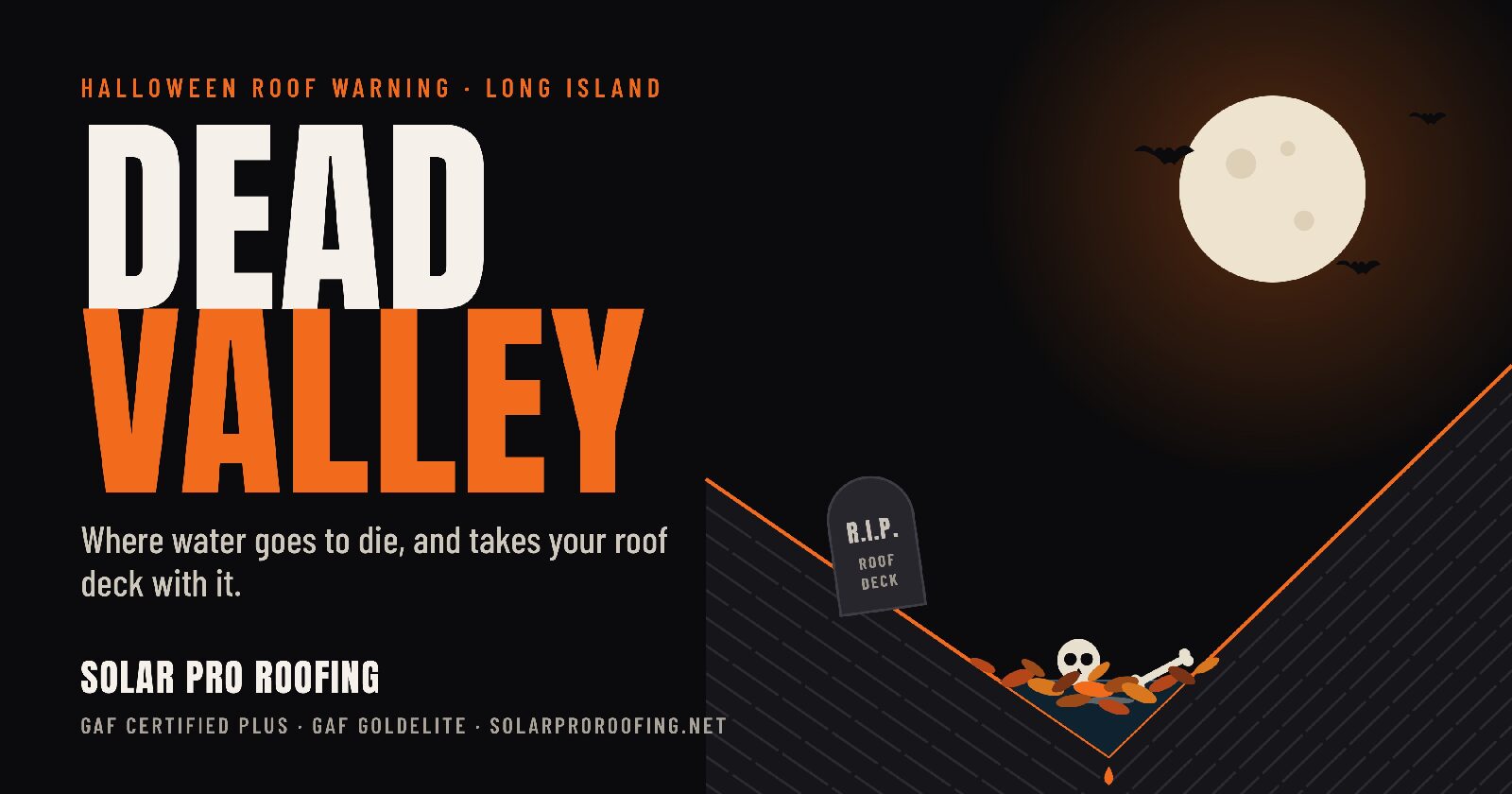
Dead valley is a real roofing term, not a pun we made up. It’s the spot where two roof sections meet, or where a roof runs into a wall, and the water has nowhere to go. Instead of flowing down and off the roof, rain, snowmelt, and wet leaves collect in a flat pocket and sit there.
That’s why roofers call it dead: no slope, no drainage, no escape.
And this time of year, it gets worse.
Why Dead Valleys Become a Bigger Problem in the Fall
Every October, falling leaves pile into dead valleys and pack down into a wet, rotting mat that holds moisture against your roof for weeks. It’s a graveyard of leaves sitting right on top of your house.
Then winter arrives. Snow drifts into the same pocket, the melt refreezes into ice, and water backs up under shingles that were never designed to sit in a puddle.
Here’s the scary part: water trapped in a dead valley soaks the roof decking, wicks into the wall sheathing behind your siding, and travels down inside the wall.
The first sign is usually a stain on an interior wall, peeling paint below a window, a soft spot in a ceiling near an addition, or a musty smell in one room.
By then, the decking and framing may already be rotting, and what should have been a roofing fix has become a rebuild.
Where Do Dead Valleys Hide?
Dead valleys commonly develop in areas where different roof sections meet, including:
- Home additions: Where a new roof connects to the original house.
- Dormers: Where roof slopes and walls create complicated transitions.
- Porch roofs: Where a roof runs directly into a wall.
- Chimneys: Especially along the back side, where water and debris can collect.
If one corner of your roof collects leaves that never clear, shows dark staining or moss in the same spot, or builds up ice every winter, you’re likely looking at a potential drainage problem.
5 Reasons Dead Valleys Require Professional Roofing Expertise
Fixing a dead valley takes real expertise, not another layer of shingles. Here’s why.
1. Shingles Can’t Handle Standing Water
Building codes generally restrict asphalt shingles on slopes flatter than 2:12. A true dead spot needs an appropriate low-slope membrane system, not shingles stretched across a flat pocket and hoped for the best.
2. The Water Needs a Way Out
The right fix often involves a cricket, also called a saddle. This is a small, framed peak built into the pocket that splits the water and directs it away from the problem area.
That means proper carpentry and drainage design, not simply applying caulk and hoping it holds.
3. The Leak Barrier Must Protect the Surrounding Area
A leak barrier needs to extend appropriately beyond the problem area so that when ice and snow back up, a waterproof layer underneath helps prevent water from penetrating the roof.
Proper placement and installation are essential to protecting the roof deck and the surrounding structure.
4. Flashing Must Be Installed Correctly
Where the roof meets the wall, siding often needs to be removed so step flashing and counterflashing can be installed correctly.
Flashing that’s simply tucked against a surface or sealed with caulk can leave vulnerable gaps where water can enter.
5. Roofing Materials Must Transition Properly
The transition between a low-slope membrane and shingles must be installed in the correct sequence, with each layer overlapping the next so water flows over the materials rather than behind them.
Get any of these details wrong, or combine incompatible components, and you risk leaks and potential problems with your manufacturer’s warranty.
That’s why the roofer matters more than the shingle.
Why October Is the Time to Inspect Your Roof
The leaves are falling now, nor’easter season is approaching, and once the freeze-thaw cycles start, a dead valley can go from a slow leak to an active one.
Booking a roof inspection before winter gives you time to identify drainage problems and address them properly before snow, ice, and freezing temperatures make repairs more difficult.
Waiting until a leak appears inside your home can mean dealing with damaged decking, deteriorating framing, and costly interior repairs.
Why Long Island Homeowners Choose Solar Pro Roofing
Solar Pro Roofing is the crew Long Island calls when the roof gets complicated.
We hold GAF Certified Plus status for residential roofing and GAF GoldElite status for commercial roofing, allowing us to offer the GAF System Plus Limited Warranty with 50 years of non-prorated coverage on qualifying roof systems, backed by our own competitive workmanship warranty.
That residential and commercial combination matters because a dead valley often sits exactly where steep-slope shingle roofing and low-slope membrane roofing meet, and many crews specialize in only one side of that line.
Founder and CEO Jarret Sherrard brings 11 years of solar industry experience. Our East Setauket-based company is licensed and insured in Suffolk County (HI-71407) and Nassau County (204556), holds an A+ BBB rating, and has hundreds of five-star Google reviews from homeowners across Long Island.
We’ll show you where the water is going, explain the recommended fix, and walk you through the scope of work and warranty before any work begins.
Don’t Let a Dead Valley Turn Your Home Into a Haunted House
The only dead thing on your house this Halloween should be the skeleton on your front lawn.
Protect your roof before winter arrives. Contact Solar Pro Roofing to schedule your roof inspection.
Call: 631-901-6144
Email: info@solarproroofing.net
Website: SolarProRoofing.net
Schedule your inspection now and make sure your roof is ready for fall rain, winter snow, and everything in between.